
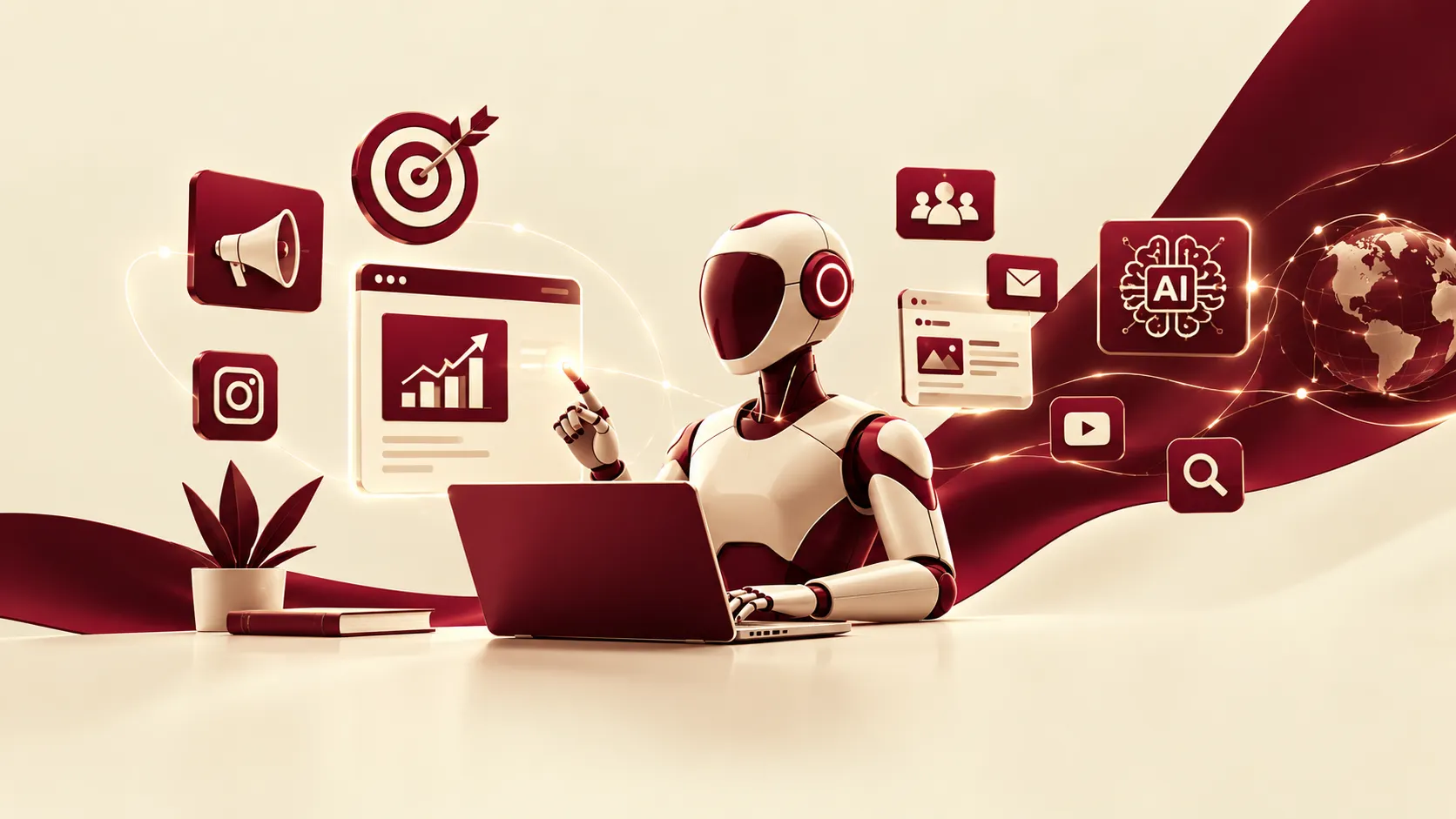
Marketing has never been more powerful—or more complicated.
How Artificial Intelligence Is Reshaping the Future of Marketing
Marketing has changed significantly in recent years. Being visible online is no longer enough. Businesses need to understand their audiences, create relevant content, communicate across multiple platforms, and measure whether their marketing efforts are actually producing results.
For modern marketers, this can mean managing social media, SEO, paid advertising, websites, content, analytics, email campaigns, and customer interactions at the same time. With digital platforms constantly changing, keeping up with everything manually can become difficult.
This is where Artificial Intelligence (AI) is changing the way marketing works.
AI can analyse large amounts of information, identify patterns, automate repetitive tasks, generate ideas, and help marketers make faster decisions. It is not simply another marketing tool. It is becoming a support system that can influence almost every stage of the marketing process.
The future of marketing is not about replacing humans with technology. It is about using technology to help marketers work smarter.
Why Modern Marketing Needs AI
Today’s businesses generate huge amounts of data through websites, social media, advertisements, search engines, and online purchases. Every click, search, interaction, and purchase can provide valuable information about customers.
The challenge is understanding what that information actually means.
Manually analysing thousands of data points can take considerable time. AI can process large datasets quickly and identify patterns that may be difficult to notice through traditional methods.
It can help marketers understand which content performs well, which audiences are more likely to convert, where advertising budgets are being used effectively, and what customers may want next.
This allows businesses to move from simply collecting data to using it for better decisions.
Understanding Customers More Effectively
Understanding customers has always been one of the foundations of successful marketing.
Traditional audience research often focuses on factors such as age, location, gender, and interests. While these details are useful, they do not always explain customer behaviour.
AI can analyse browsing activity, search behaviour, purchases, content interactions, and other digital signals to identify behavioural patterns.
For example, an online store may notice that a customer repeatedly visits a particular product category. AI can help identify this interest and support more relevant recommendations or marketing messages.
Instead of communicating with everyone in the same way, businesses can create experiences that are more closely connected to individual customer needs.
Faster Content Creation
Content is at the heart of digital marketing. Businesses need blogs, social media posts, advertisements, emails, videos, product descriptions, and website content on a regular basis.
Producing quality content consistently requires both time and creativity.
AI can support marketers by generating content ideas, creating outlines, suggesting headlines, improving drafts, and adapting existing content for different platforms.
However, AI should not replace human creativity.
AI can generate information and ideas, but marketers understand a brand’s personality, audience, emotions, and goals. Human input is essential for making content authentic and meaningful.
The most effective approach is to use AI as a creative assistant while keeping strategy and final decisions in human hands.
Personalised Marketing Experiences
People see countless marketing messages every day. Generic content can easily become invisible.
Personalisation helps businesses deliver messages that are more relevant to individual customers.
AI can analyse customer behaviour and support personalised recommendations, emails, advertisements, website experiences, and offers.
For instance, a customer who regularly interacts with fitness products may receive content related to fitness rather than completely unrelated promotions.
This makes communication more relevant and can help businesses build stronger relationships with their audiences.
Smarter Digital Advertising
Digital advertising produces large amounts of performance data. Marketers need to monitor clicks, impressions, conversions, audience behaviour, creative performance, and spending.
AI can analyse these signals and help identify opportunities for campaign optimisation.
It can support marketers in understanding which audiences are responding, which creatives are performing better, and where budgets may be used more effectively.
However, successful advertising still requires human strategy. Marketers need to understand the business objective, audience, message, positioning, and creative direction.
AI can make optimisation faster, but it cannot replace strategic thinking.
Predicting Customer Behaviour
Another important application of AI is predictive marketing.
Traditional marketing often focuses on what has already happened. AI can help businesses identify patterns that may indicate what customers could do next.
For example, AI may help identify customers who are more likely to purchase, respond to an offer, or stop engaging with a brand.
These insights allow businesses to plan ahead. They can adjust campaigns, prepare offers, improve customer experiences, or focus their resources on opportunities with greater potential.
This makes marketing more proactive rather than purely reactive.
Improving Customer Support
Customers increasingly expect quick answers. They may want information about products, prices, delivery, availability, or services at any time of the day.
AI-powered chatbots and virtual assistants can handle many routine questions quickly and consistently.
They can provide immediate responses and allow human teams to focus on more complicated issues that require personal attention.
However, automation should not remove the human side of customer service. Some conversations require empathy, understanding, and genuine human interaction.
AI works best when it handles repetitive tasks while people manage situations where human judgement matters.
The Changing Role of Marketers
As AI becomes more advanced, many marketers wonder whether technology will replace their jobs.
A more likely outcome is that AI will change the role of the marketer.
Repetitive tasks can increasingly be automated, giving marketers more time to focus on strategy, creativity, storytelling, branding, and customer relationships.
Future marketers may therefore need both marketing knowledge and AI skills.
The valuable skill will not simply be knowing how to generate content using AI. It will be understanding what needs to be created, who it is for, why it matters, and how it contributes to a larger business goal.
AI and the Human Element
Despite its capabilities, AI cannot completely replace the human side of marketing.
People connect with stories, emotions, experiences, values, and authentic communication. Algorithms can identify patterns, but humans provide creativity, empathy, judgement, and cultural understanding.
This is why the future should not be viewed as AI versus humans.
It should be AI working with humans.
AI can handle information, automation, and repetitive processes, while marketers provide direction, creativity, emotion, and strategic thinking.
Together, they can create marketing that is both efficient and meaningful.
Conclusion
Artificial Intelligence is reshaping marketing by changing how businesses understand customers, create content, manage advertising, personalise experiences, analyse data, and plan future strategies.
Its greatest value is not simply automation. It is the ability to turn complex information into useful insights and help marketers make better decisions.
Businesses that learn to use AI effectively can improve efficiency, save time, understand their customers better, and create more relevant experiences.
However, technology alone cannot build a successful brand. The strongest marketing strategies will combine the speed and analytical power of AI with human creativity and understanding.
The future of marketing is not about removing people from the process. It is about giving them better tools to create better results.
