
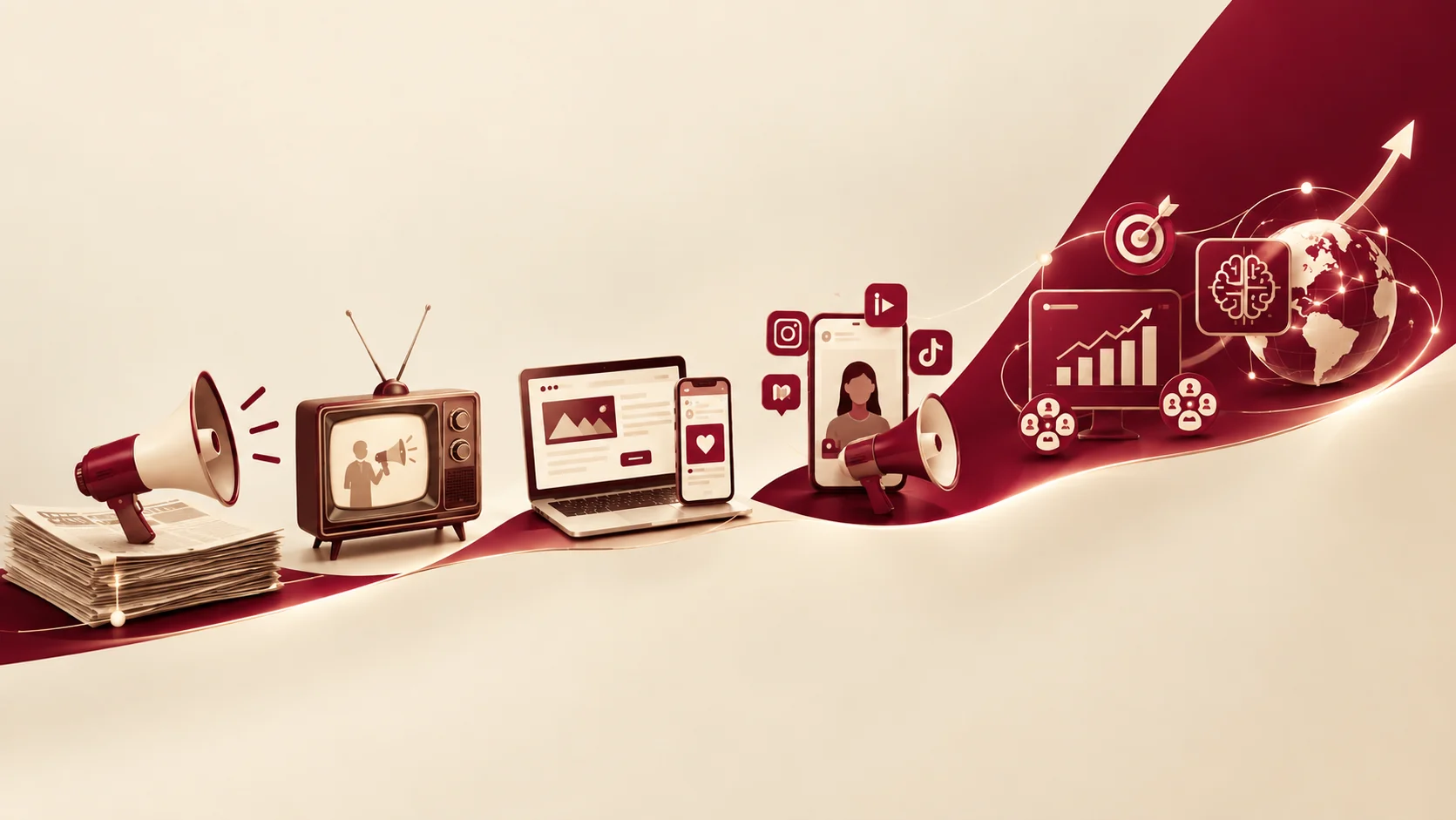
Take a look at the way people spend an ordinary day. Someone may watch a short video while having breakfast, search for a product during a break, read a review before lunch, and receive a promotional message later in the evening. Without deliberately searching for advertisements, that person has already come across several marketing messages.
This tells us something important about the world of business today. Marketing is no longer limited to a newspaper page, a television screen, or a large board beside a road. It has become part of the digital spaces people visit every day.
But getting from traditional advertising to today’s digital environment did not happen overnight.
There was a time when businesses had a much smaller number of ways to reach potential buyers. A shop could print an announcement, distribute leaflets, sponsor a radio programme, or purchase television space. The business prepared the message, selected the place where it would appear, and waited for people to notice it.
This approach could work very well, especially for companies with enough money to reach large audiences. However, the business had limited knowledge about what happened after the advertisement was published.
The arrival of the internet started to change that situation.
A company could create a website and provide information without depending on a newspaper editor or television schedule. A person looking for a particular service could find a business through a search engine. Instead of seeing advertisements only when companies decided to show them, people could actively look for what they needed.
That small change had a big effect.
The customer gained more control.
People could compare products from different companies, check prices, read opinions, watch demonstrations, and decide when they were ready to make contact. Businesses had to become more informative because customers could easily move to another option if they were not satisfied with what they found.
Social media added another layer to this change.
Earlier, a business could speak to its audience, but getting an immediate response was not always possible. Social platforms removed much of that distance. A business could publish something in the morning and receive questions, opinions, and reactions shortly afterwards.
This created a more open relationship between companies and customers.
A customer could praise a business publicly. They could also point out a problem. Someone who had never purchased from the company could read those comments and form an opinion based on another person’s experience.
For businesses, this meant that marketing could no longer be treated as a separate activity from the actual quality of the business.
If an advertisement promises excellent service but the customer receives poor treatment, the advertisement loses its value. The experience becomes part of the marketing story whether the company planned it or not.
Digital platforms also introduced something that changed how marketers make decisions: access to information about what people actually do.
A website can provide clues about which pages attract visitors and where people stop browsing. An advertising campaign can show which message receives more attention. Social media can reveal which topics create discussion.
These signals can help a business notice problems that might otherwise remain hidden.
Consider a small online store. Its advertisements may be bringing visitors to the website, but sales remain low. Instead of immediately increasing the advertising budget, the owner can look at what happens after visitors arrive.
Perhaps the product photographs are poor. Maybe important details are missing. The payment process might be confusing. The price may not be explained clearly.
Finding the actual obstacle is often more useful than simply attracting more people.
This is where modern marketing becomes closely connected with learning.
At the same time, there is something that no analytics dashboard can completely measure: the reason a person feels comfortable choosing one brand over another.
People remember experiences. They notice how a company speaks to them. They may prefer a familiar brand because it feels dependable, or choose a smaller business because its communication feels personal.
Numbers can provide clues, but understanding people still requires observation, creativity, and common sense.
Artificial intelligence is now changing the way marketers handle many of these tasks.
An AI tool can help someone organise research, generate possibilities, examine information, prepare a first draft, create visual ideas, or reduce repetitive work. This can be especially useful when a marketer has several tasks to complete within a short period.
However, convenience does not automatically mean quality.
Suppose an AI system creates an advertisement for a family-owned business. The result might look professional, but it could completely miss the character of the business. It may use language that feels unnatural to its customers or suggest an idea that does not fit the brand.
A person who knows the business still needs to make the final decisions.
This is why the future of marketing is unlikely to be about humans disappearing from the process. It is more likely to be about people using intelligent tools to work faster while keeping responsibility for the ideas and decisions.
The same change can be seen in online search.
People are increasingly comfortable explaining what they want in full sentences. Instead of searching for two or three words, someone might describe a problem and expect the search system to understand the situation.
AI-powered search is making this behaviour more common.
For businesses, this creates a new challenge. Having a website is not enough. The information on that website needs to be useful, understandable, accurate, and organised properly.
Search Engine Optimisation still plays an important role, but the wider search environment is developing. Answer Engine Optimisation and Generative Engine Optimisation are becoming relevant as people begin using systems that provide direct answers instead of simply displaying pages.
This means businesses have a stronger reason to create content that actually helps people.
The same principle applies to personalised marketing.
People receive an enormous amount of promotional content every day. Most of it disappears from their attention within seconds.Something becomes more interesting when it connects with a genuine need orinterest.
For example, an online store might show products related to what a visitor has previously explored. A business might send different information to different groups instead of sending the same message to everyone.
Used carefully, this can make communication more useful.
But there is also a limit. Customers should not feel uncomfortable because a company knows too much about them. Responsible use of information is therefore becoming an important part of modern marketing.
Another major change is the way people move towards a purchase.
There is rarely one fixed path anymore.
A person could discover a company through a video, forget about it, come across the name again on social media, search for it several days later, read reviews, visit the website, and finally make contact.
Each interaction adds a small piece to the person’s opinion.
This means the website, social content, reviews, advertising, visual identity, communication style, and customer support all have a role to play.
Looking towards the future, marketing will become even more connected with technology. Artificial intelligence will support more everyday tasks. Search systems will become better at understanding natural questions. Automation will reduce repetitive work, and businesses will have more opportunities to communicate with specific groups of people.
But adopting every new technology is not necessarily smart.
A business should first understand its own situation. If a new tool saves time or improves the experience for customers, it may be useful. If it is being used simply because everyone is talking about it, it may create more noise than value.
That is perhaps the biggest lesson from the evolution of marketing.
The industry has changed from printing messages and waiting for attention to creating conversations, studying behaviour, solving problems, and improving experiences.
Technology has changed the tools, but people are still the reason those tools exist.
A successful business does not need to use every platform or every new piece of software. It needs to understand the people it serves and communicate with them in a way that feels useful and genuine.
The next chapter of marketing will bring technologies that we cannot fully predict today. Some will become important, while others will disappear as quickly as they arrive.
What will remain important is the ability to adapt.
If your business is ready for the next stage of marketing, begin with a clear understanding of your customers, use technology where it genuinely helps, and create experiences worth coming back to.